


TempGuard Networks in Brazil: How AI-Driven IoT Predicts Temperature Failures in Cold Chains
| Quick Look: Use Case Summary | |
|---|---|
| Supporting Themes | LoRaWAN® Education |
| Industry | Cold-Chain Monitoring |
| Sub-Industry | Retail, Pharmaceutical Logistics, and Supermarket Refrigeration |
| Deployment Area | Large buildings or Industrial Settings |
| IoT Stack Used | BLE temperature sensors, BLE-to-LoRaWAN bridges, RAK7268CV2 gateway |
Highlights
TempGuard Networks combines Bluetooth Low Energy (BLE) technology with artificial intelligence (AI) to predict temperature failures. They needed a simple way to monitor every cooler in crowded pharmacies and supermarkets that contains medicines and frozen food. Bluetooth sensors alone could not cover the space, so TempGuard Networks added four BLE-to-LoRaWAN bridges and one RAK7268CV2 gateway per branch. The RAK hardware pushed steady data through thick concrete walls. TempGuard Networks now sees live temperatures every three seconds, catches problems early, and lowers hardware and support costs.
Company Introduction
TempGuard Networks is a Brazilian cold-chain management company that helps supermarkets and pharmacies stop hidden temperature failures. Its work focuses on real-time cold chain monitoring for environments where small temperature changes can create serious losses. They have revolutionized how temperature is monitored across various stages of the cold chain, from products in transit to those in storage.
Their innovative approach combines BLE with AI to catch temperature problems before they spoil food or medicine. This approach supports AI cold chain monitoring IoT by turning frequent temperature readings into early warnings. TempGuard Networks set out to spot those slips before they turn into emergencies.
Problem
We must watch the temperature of coolers (pallets) inside chambers for the pharmaceutical market. If readings slip even once, the drugs can spoil, and the entire shipment and inventory are lost. Without real-time cold chain monitoring, teams may only discover the issue after the damage has already happened.
A weak monitoring system risks patient safety, compliance, and revenue. This risk is especially serious in pharmaceutical cold chain IoT, where every temperature reading can affect product safety.
Location
Brazil
The Challenge
The pharmaceutical sector cannot afford a single lapse in temperature control because even a brief spike can ruin delicate medicines. This makes predictive temperature monitoring difficult when data is delayed, incomplete, or not frequent enough.
A single store may run multiple refrigerators, and each cooler sits inside a concrete chamber full of metal racks and moving forklifts. These conditions also make supermarket cold chain monitoring harder when standard wireless signals cannot move reliably through the space. This is why standard Wi-Fi usually drops out in these spaces.
TempGuard Networks needed a system that tracks every cooler in real time and predicts trouble before it starts. Deploying a solution based solely on BLE sensors presented an initial challenge. BLE and LoRaWAN temperature sensors had to be considered together because each technology solved a different part of the coverage and data-frequency problem.
BLE sensors cannot cover a large storage space on their own due to their limited range. If Temprecord went for this option, they needed to install several extra gateways which would:
- Drive up significant cost and maintenance overhead
- Clutter the site with system complications
- Make the network tougher to manage
On the other hand, direct LoRaWAN seemed like an excellent option for long-range communication in this case. However, TempGuard Networks found that direct LoRaWAN temperature sensors weren’t viable either for two key reasons:
- Placing a LoRaWAN temperature sensor on every cooler would be too costly in comparison to BLE sensors.
- LoRaWAN has duty cycle limitations and can't push updates within the 3-5 seconds window that the AI model needs.
Thus, the company needed to design a hybrid network that utilizes these two options in the most favorable combination. Overall, from this challenge, three clear needs emerged for TempGuard Networks:
- Wide coverage from 1 gateway, so managers do not have to install dozens of repeaters or gateways.
- Stable data flow every 3-5 seconds, so the AI model could predict and spot small drifts in temperature curves.
- One network and one dashboard for chain owners to scale the system to many branches with low costs.
The Solution
A Hybrid BLE-LoRaWAN IoT Network
TempGuard combined the best parts of the two wireless systems. They chose to use BLE sensors in conjunction with BLE-to-LoRaWAN bridges. To execute this, they kept the low-cost BLE sensors on every cooler, so the AI engine could still receive a fresh temperature point every few seconds.
Secondly, instead of adding dozens of extra access points, they introduced four small bridges that translate those BLE readings into LoRaWAN packets. One RAK LoRaWAN gateway then carries all traffic across the entire store and up to the cloud.
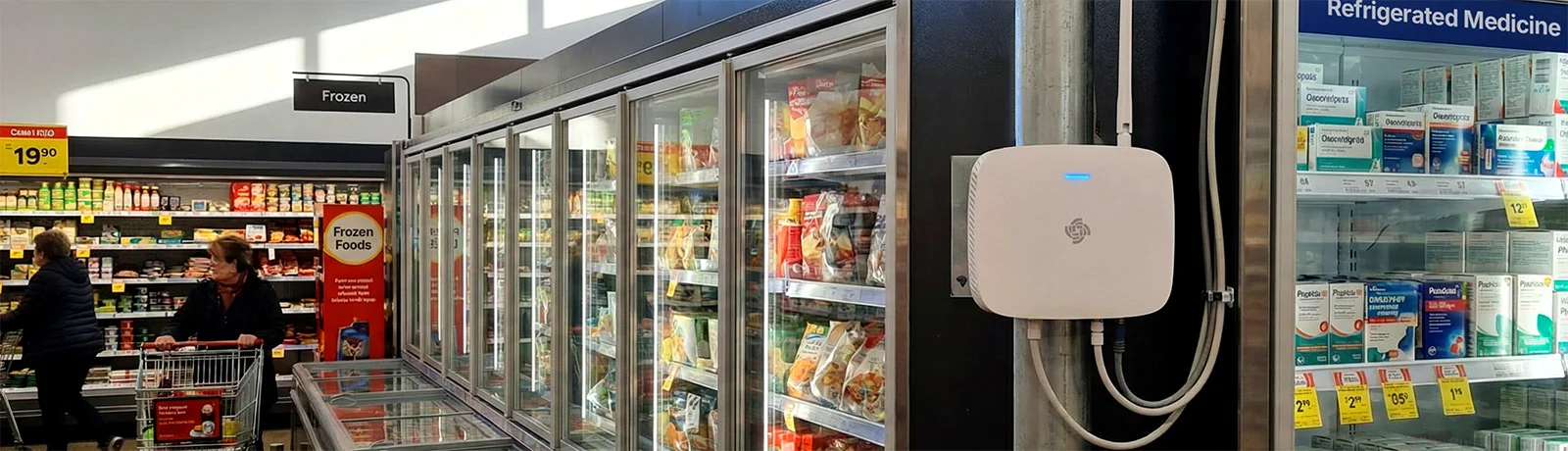
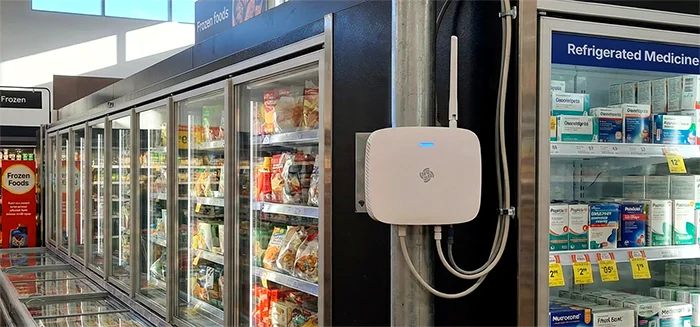
The RAK7268CV2 LoRaWAN gateway helped simplify the network while keeping temperature data moving from the cold rooms to the cloud. This star-shaped layout stayed inexpensive, met the high-frequency update rate, and left the team with a single network to monitor rather than a maze of separate systems.
In summary, for every 80 refrigerators within the supermarkets and pharmacies, they deployed:
- 80 BLE temperature sensors for each refrigerator
- 4 BLE-to-LoRaWAN bridges, referred to as nodes that connect to the gateway
- 1 RAK LoRaWAN gateway
Why Does This Setup Work?
| Advantage | What does it mean in daily operation? | Why does it matter for cold-chain safety? |
|---|---|---|
| Fewer Gateways to Manage | One LoRaWAN gateway gathers data from every bridge so staff can set up and maintain a single box instead of many. | Less hardware lowers cost, shortens installation time, and reduces the chance of a misconfigured unit. |
| Strong & Stable Signals | LoRaWAN reaches through concrete, metal racks, and long aisles. Each bridge also stores readings briefly, so no data disappears when a packet fails. | The network delivers updates every three seconds without gaps, giving teams a live view of every cooler. |
| Early & Accurate Alerts | Sensors log temperature changes in real time and send them straight to the cloud. | Supervisors spot rising heat before vaccines spoil, avoid recalls, and keep customers safe. |
| Cost Efficiency | BLE sensors cost about $10 each, along with BLE-to-LoRaWAN bridges. This results in a total deployment cost of around $1000. While direct LoRaWAN sensors would cost around $2400, making BLE a more budget-friendly option for large-scale deployments. | TempGuard Networks can place sensors on every cooler instead of skipping units to save money. This will allow better monitoring. With fewer gateways and a simple (bridge + gateway) design, the network stays stable, alerts reach the team on time, and spoilage may be better controlled. |
This blended network turned a patchwork of sensors into one smooth system. TempGuard Networks now sees every cooler on a single screen, and staff spend less time chasing hardware issues and more time protecting valuable stock. TempGuard Networks had to keep every reading steady because a bad temperature can ruin food and medicine quickly. They needed an IoT solution that stays reliable so they would not lose money or upset customers. This need for reliability played an important part in their decision to select RAKwireless.
Why TempGuard Networks Chose RAKwireless?
- Product Stability and Performance: Rakwireless has solid and well-performing hardware. Therefore, our gateways and bridge devices run day after day without dropping data. Every temperature reading remains correct and on time even in tough store conditions.
- Communication and Documentation: In addition to product performance, TempGuard Networks highlighted the clear English communication and comprehensive documentation provided by RAKwireless as key factors in their decision. Our easy-to-read guides walk users through every step. Thanks to this clear help, TempGuard Networks set up the hardware fast and had the whole system running with very little effort.
BLE-to-LoRaWAN Bridge Architecture vs Direct LoRaWAN Uplink
When you pick sensors for temperature monitoring, the setting guides the right mix of BLE and LoRaWAN. This is why BLE and LoRaWAN temperature sensors work well when many refrigerators need frequent readings in one building.
Think first about how many sensors you will place and how far their data must travel. The quick guide below shows where a blended BLE-to-LoRaWAN approach works and where a direct LoRaWAN path is the better choice.
Comparative Matrix
High Sensor Density Areas (Many sensors are packed close together)
Best Pick of Devices
BLE sensors with 4 BLE-to-LoRaWAN bridges and 1 LoRaWAN gateway.
Why Does it Work?
Low-cost BLE units run for years. Fewer gateways cut network clutter, and there’s less chance of failure.
Real-World Fit
Large warehouses, food plants, or labs that track dozens of coolers in one building.
Long-Range Connectivity Areas (Sites spread over long distances)
Best Pick of Devices
Direct LoRaWAN Deployment
Why Does it Work?
A LoRaWAN node talks straight to the gateway over kilometers and uses little power. No need for extra bridges.
Real-World Fit
Cattle pastures, crop fields, and water meters along a pipeline.
Low Sensor Density Areas (Small sensor count in one spot)
Best Pick of Devices
Direct LoRaWAN Deployment
Why Does it Work?
The cost gap between BLE sensors with bridges and direct LoRaWAN sensors is small when you only need a few units. This allows simpler installation and easy scale-up.
Real-World Fit
A single walk-in freezer or a remote equipment shed.
| Deployment Type | Best Pick of Devices | Why Does it Work? | Real-World Fit |
|---|---|---|---|
| High Sensor Density Areas (Many sensors are packed close together) | BLE sensors with 4 BLE-to-LoRaWAN bridges and 1 LoRaWAN gateway. | Low-cost BLE units run for years. Fewer gateways cut network clutter, and there’s less chance of failure. | Large warehouses, food plants, or labs that track dozens of coolers in one building. |
| Long-Range Connectivity Areas (Sites spread over long distances) | Direct LoRaWAN Deployment | A LoRaWAN node talks straight to the gateway over kilometers and uses little power. No need for extra bridges. | Cattle pastures, crop fields, and water meters along a pipeline. |
| Low Sensor Density Areas (Small sensor count in one spot) | Direct LoRaWAN Deployment | The cost gap between BLE sensors with bridges and direct LoRaWAN sensors is small when you only need a few units. This allows simpler installation and easy scale-up. | A single walk-in freezer or a remote equipment shed. |
Market reality adds one more detail. Blending BLE and LoRaWAN takes technical skill and experience. This can slow the adoption of AI cold chain monitoring IoT when teams do not have radio or deployment expertise.
The complexity may explain why such solutions are not yet widespread. Teams without radio experience, like a retailer in Hong Kong, often skip the bridge layer and choose direct LoRaWAN to avoid extra setup work. However, an all-in-one kit that bundles BLE sensors and ready-made bridges can better solve that barrier and let more users enjoy the savings of a mixed network.
The choice between BLE sensors with LoRaWAN bridges and direct LoRaWAN deployment depends on factors such as sensor density, cost, and technical requirements. For high-density deployments, the BLE-to-LoRaWAN bridge solution offers a cost-effective and manageable approach. For low-density or long-range scenarios, direct LoRaWAN may be more suitable.
Conclusion
TempGuard Networks’ success in deploying an advanced cold-chain management solution demonstrates the power of combining AI with IoT technology. It shows how AI cold chain monitoring IoT can help teams predict temperature failures instead of only reacting after damage occurs.
Their choice of RAKwireless highlights the importance of reliable product performance and underscores excellent communication and support. TempGuard Networks is now rolling out the system in Carrefour supermarkets across Brazil, and RAKwireless will keep supplying top products and strong support as that setup grows. This rollout also highlights the value of supermarket cold chain monitoring at scale.
Getting Started
Don’t wait for a failed audit or spoiled shipment.
Contact us today and design a LoRaWAN network that sends steady temperature data from the busiest aisles to the cloud in seconds.
Contact us today and design a LoRaWAN network that sends steady temperature data from the busiest aisles to the cloud in seconds.
