


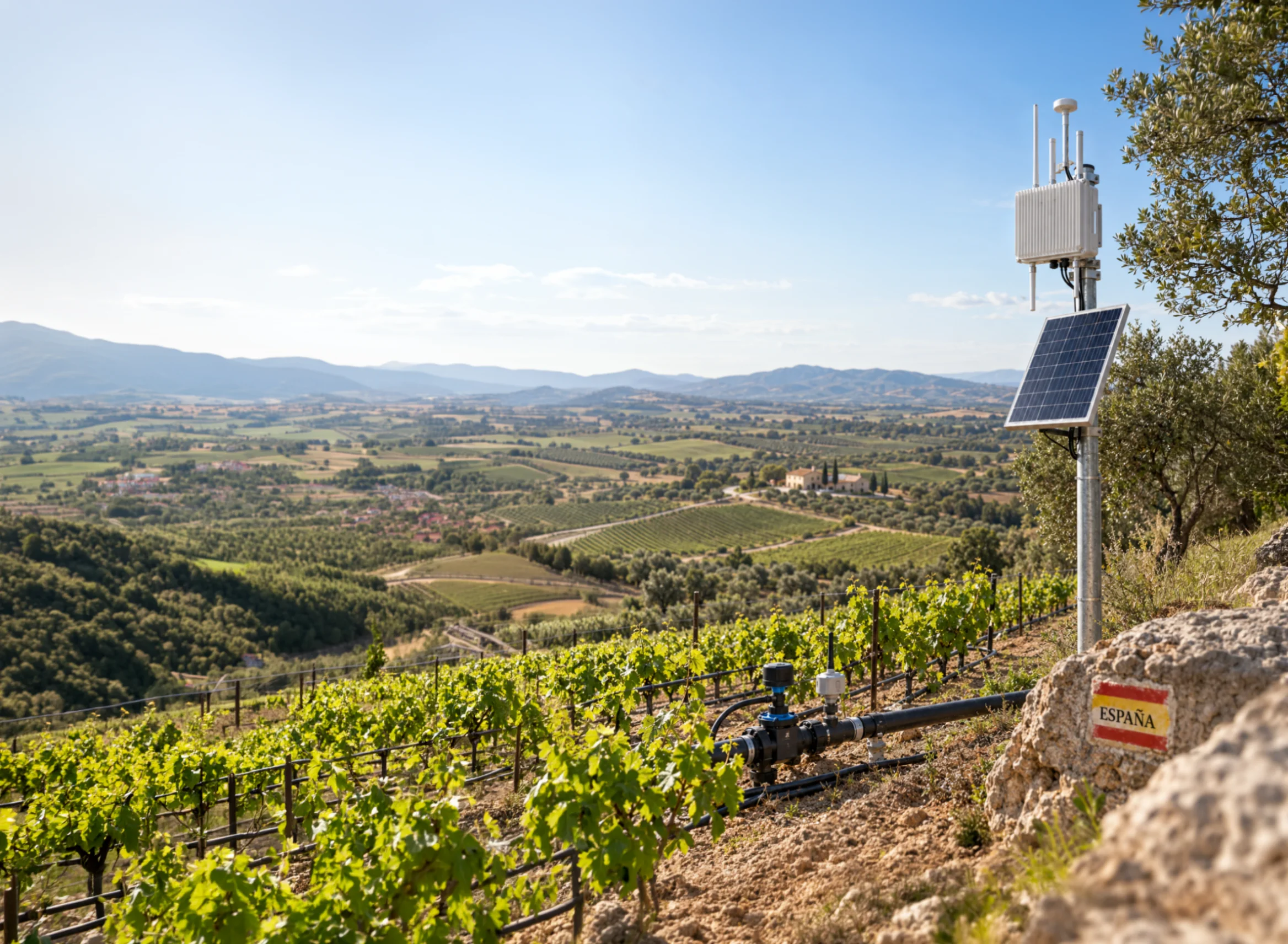
Terrawise Transition to RAKwireless LoRaWAN® for Government-Funded Irrigation Projects
| Quick Look: Use Case Summary | |
|---|---|
| Industry | Agriculture |
| Sub-Industry | Smart Irrigation and Water Management |
| Deployment Area | Farms with large or remote fields. |
| IoT Stack Used | RAKwireless IoT hardware (RAK7285 gateways, RAK9155 solar battery, flow detectors, pressure switches), Agrónic App 2.0, LoRaWAN connectivity |
Highlight Summary
- Terrawise upgraded from proprietary LoRa® to LoRaWAN smart irrigation for government-funded farm projects.
- The shift supported LoRaWAN irrigation monitoring with better standardization, interoperability, and smart water management.
- RAKwireless provided IoT agriculture solutions with RAK7285 gateways and RAK9155 solar battery units.
- The system helps farmers monitor water flow, pressure, leaks, and irrigation status in real time.
- A solar powered LoRaWAN gateway supports large farms with limited access to fixed power.
- Farmers can manage irrigation remotely through mobile alerts and connected field data.
- The solution improves water efficiency and supports sustainable smart farming IoT.
Company Profile
Water is becoming a scarce and valuable resource for farmers in the agricultural industry. Managing it well has never been more important, as climate change is making farming harder day by day. One company working to address these challenges is Terrawise, an innovative irrigation company in Spain that is helping farmers manage water more efficiently.
The company originally used a proprietary LoRa protocol to reach distant fields and for a greater range in their systems. However, a government-funded project required all systems to switch to LoRaWAN, so Terrawise upgraded to meet the new regulatory standards. This use case article explains the background of this government initiative, why Terrawise chose LoRaWAN, and how RAKwireless solutions helped improve irrigation control and efficiency across farms.
Problem Statement
Managing water supply nowadays has become a challenging ordeal for farmers. Water remains scarce and crops require more water over time to grow sufficiently. Farmers often waste water and energy with conventional irrigation systems, and it is also difficult to pinpoint problems like leaks or pressure drops until much later. This delay hurts crop health and raises costs.
Many farms also stretch across wide fields where it feels impossible to keep watch all the time. The whole industry feels the need for smarter control of irrigation so that every drop serves a purpose and farming remains strong for future generations.
Location
Spain
Government Funding for Sustainable Irrigation
Spain faces a growing water scarcity problem that climate change makes worse. Winter droughts have shown that farmers need better ways to manage water.
In response, the government of Spain has started a new project with support from the Next Generation EU (NGEU) funds. The main focus of the project is to upgrade the existing irrigation systems to save water and energy. This has made water management IoT more important for farms facing drought and rising costs.
The following are the key objectives of the government initiative:
- Transform irrigation systems: The project aimed to upgrade old setups with advanced technology. This helped farmers utilize water more smartly and allowed fair resource management nationwide.
- Promote water and energy saving: The plan encouraged farmers to use smart irrigation systems and electricity from renewable energy sources like solar. It also pushed them to use non-conventional water sources like reclaimed or desalinated water. This way, farmers had a more reliable supply in dry seasons.
- Adapt to climate change: The initiative aimed to help farmers deal with droughts and changing weather. Farms could save more crops with stronger agricultural systems in place. This helped keep the food supply steady even as water resources grew harder to find.
The project required all systems to follow standardized communication protocols like LoRaWAN to achieve these goals. That is why LoRaWAN became essential, as it allows devices from different makers to work together. This made the solutions more compatible and improved their interoperability across regions.
Terrawise Initial Approach with Proprietary LoRa Protocol
Terrawise had initially implemented a proprietary LoRa protocol in its irrigation systems. The setup provided a greater range and reliable communication for their irrigation leak monitoring solutions. These systems optimize water use for farmers. They show the exact condition of each irrigation area in real time and also detect possible leaks or malfunctions.
Main features of Terrawise proprietary solutions:
- Flow Detectors: Installed in each sector to ensure irrigation solenoid valves operate correctly.
- Digital Pressure Switches: Monitor the irrigation status and detect leaks based on specific pressure settings.
- Auxiliary Irrigation Meters: Measure the flow in each sector and warn about breakages and leakages.
These tools created an early form of IoT irrigation control for remote farm areas. They reduced water waste and labor costs to a significant extent, and allowed farmers to manage their irrigation systems from remote areas.
Transition to LoRaWAN for Government Projects
Terrawise upgraded their old proprietary LoRa system to LoRaWAN to take part in the government-funded project. The government sets this requirement because LoRaWAN is a standard protocol that ensures all systems work properly together. This move made LoRaWAN agriculture a stronger fit for large government-backed farm projects.
Why the government requires LoRaWAN connectivity:
- Standardization: Makes sure that different systems work together without any glitches.
- Interoperability: Facilitates easy integration with other technologies and systems that are used in the project.
- Scalability: Supports large-scale deployment across various regions and farms.
Farms that have this protocol installed could rely on a common language that links sensors, gateways, and platforms without any conflict. This gave Terrawise the chance to reach more regions and serve farmers in a more effective way.
The company also gained the opportunity to create new tools that worked in harmony with other technologies already in use across the country. This upgrade strengthened daily operations and built long-term value for all the stakeholders.
From Protocol to Practical Needs
Now that Terrawise shifted to LoRaWAN, the company had to decide which IoT systems could best support the upgrade on real farms. Other than meeting the government requirement, the goal was also to make sure the technology worked well in the field. This is because farms are often spread across wide areas and have no stable power supply and limited access to technicians. They needed a farm monitoring system that could work across wide fields and remote areas.
The choice of hardware and software became a critical step for them. Terrawise needed gateways that could cover long distances and seamlessly connect all the sensors together. This made LoRaWAN for farms a practical choice for wide fields and remote irrigation sites. They also needed power options that did not depend on the grid because many farms operate in places where electricity is mostly unavailable.
At the same time, the system should be easy to set up so that farmers and technicians can run it without wasting time. Agricultural IoT connectivity had to stay reliable even where power and technicians were limited. Terrawise was in search of IoT solutions that could provide reliable coverage, simple deployment, and independence from fixed power sources.
These requirements pointed them toward RAKwireless' latest IoT hardware. RAK's suite of IoT products met their demands for both the government project and the daily realities of farming.
The Solution
Terrawise had evaluated multiple IoT solution providers and finally chose RAKwireless to meet the government project requirements and improve their overall irrigation systems. The key components for this upgrade were the RAK7285 full duplex gateway and the RAK9155 solar battery. The RAK7285 worked as a LoRaWAN gateway for agriculture across large and remote fields.
The following are the reasons for choosing RAKwireless solutions:
-
Built-in Network Server
RAKwireless solutions come with a built-in network server. Farmers can set them up on-site without extra steps. This keeps communication safe and steady, which is very important for farms spread across wide and remote areas. -
Ease of Use and Configuration
The RAKwireless LoRaWAN technology is easy to use and straightforward to configure. It quickly integrates with existing systems and has a minimal setup time. -
Wide Coverage
The RAK7285 gateway provides extensive coverage and ensures that even the most distant segments of the farm are connected. This is essential for maintaining continuous monitoring and control of irrigation systems. -
Renewable Integration
When LoRaWAN is paired with the RAK9155 solar battery, the RAK7285 gateway can be deployed anywhere on the farm. Farmers no longer have to rely on the grid, and it is a great advantage on large and medium-sized farms when supervisors cannot stay in one spot throughout the day.
With these features, RAKwireless gives farmers a reliable system that supports daily work operations. The gateways cover the land, the solar power keeps them running, and the setup stays simple for anyone to use.
Implementation and Benefits Realized
Terrawise brought RAKwireless LoRaWAN technology into their irrigation control systems. This upgrade improved system performance and also met compliance with the new regulatory requirements. Farmers began to see many clear benefits once the system went live, like:
-
Real-Time Monitoring and Control
LoRaWAN flow detectors and pressure switches send live data straight to the main system. Farmers can see water flow and pressure at once and take action without delay. This quick response helps them spot leaks early and fix problems before they spread. -
Remote Management
Farmers get instant notifications on their Android or iOS devices with the RAK7285 gateway and the Agrónic App 2.0. They no longer have to be physically present on the farm to manage irrigation schedules and monitor system status. -
Scalability
The RAK9155 solar battery, together with the RAK7285 gateway, works in any part of the farm and does not rely on the power grid. Farmers can place units where they are most needed. This freedom matters most on large farms where walking across fields takes hours and direct supervision is not always possible. -
Improved Water Efficiency
The system helps farmers use only the water that crops need. It reduces waste and keeps fields healthy while saving energy at the same time. This also fulfills the government’s goal to protect water resources and promote smart farming practices.
With such a system in place, water goes where it is needed, and farmers no longer have to waste hours checking every corner of the land.
The Outcome
Terrawise moved to LoRaWAN technology for government-backed irrigation projects and showed how modern tools can reshape farming. With RAKwireless solutions, they strengthened their irrigation systems and made water use smarter and more efficiently. This step also proved that standardization and interoperability help farms face big challenges like water shortage and climate change.
Connect Today!
See how LoRaWAN can make irrigation smarter and easier for farms of every size.
We are here to help you build reliable systems that save water and improve crop health.
We are here to help you build reliable systems that save water and improve crop health.

