


Tecsino and RAKwireless Modernizing Utility Telemetry in Brazil
| Quick Look: Use Case Summary | |
|---|---|
| Industry | Utilities (IoT-based infrastructure management) |
| Sub-Industry | Water, Gas, and Electricity Metering and Telemetry |
| Deployment Area | Urban and residential regions |
| IoT Stack Used | RAK7289V2 Outdoor Gateway, RAK3172 Module, WisDM Device Management, and LoRaWAN® Network |
Highlights Summary
- Tecsino is a company in Brazil that offers smart meters and a telemetry platform to help utility providers manage gas, water, and electricity services.
- As Tecsino’s network grew, the company struggled with limited signals, poor scalability, and outdated Zigbee systems.
- Traditional utility telemetry made scalable data collection difficult, which increased the need for IoT for utility companies.
- By switching to a LoRaWAN network with RAKwireless hardware and the WisDM platform, Tecsino improved connectivity, gained full control, and made their utility network more secure and easy to manage.
- With RAKwireless technology as the foundation, they plan to keep growing and improving their platform to reach more cities across Brazil.
Company Profile
The need for efficient utility management grows every day as cities expand and infrastructure demands increase. Tecsino's main aim is to improve the existing work operations of utility companies in Brazil.
Tecsino builds smart meters for water, gas, and electricity, and also offers a platform that links this data directly to billing systems. Its platform supports smart water metering and smart gas metering for utility providers. This helps utility providers control their networks and use real-time information to make decisions. The solution also supports an electricity telemetry solution for connected utility infrastructure.
Over time, Tecsino has earned a strong reputation by using modern communication technologies such as LoRa®, Sigfox, and LTE. These technologies help utility companies to monitor resources from remote areas and ensure smooth operations. With major clients like Comgas, Tecsino continues to expand and upgrade its solutions to meet the growing demands of modern cities.
Problem Statement
As more cities adopt IoT (Internet of Things) for utility management, problems like weak signal reach, slow data transmission, and system breakdowns become more common. Most utility companies still rely on outdated networks, which do not provide the coverage and control necessary for critical operations. These networks often leave communication gaps, particularly in remote and densely populated areas. As a result, companies face delays, lose important data, and spend more resources on maintenance and support.
It is difficult for many utility providers to collect accurate data from the field. Their current systems often rely on outdated or limited technologies that cannot support a growing number of utility meters. Without a strong and flexible connectivity solution, it becomes hard to:
- Scale operations
- Meet customer expectations
- Reduce costs
As Tecsino grew and installed more IoT devices in the field, the old Zigbee system started to fall behind. This made network scalability increasingly important as the number of IoT smart meters grew. Platforms like Zigbee were never designed for large-scale utility networks because Zigbee relies on a mesh network.
This became an important consideration when evaluating LoRaWAN vs. Zigbee mesh networks. Essentially, each new device adds pressure to the system by relying on nearby nodes to relay data. When companies try to expand and install more smart meters, their existing Zigbee-based gateways reach their limits. The overall network struggled to cover large areas and support thousands of IoT devices at once.
Location
Brazil
How LoRaWAN’s Star Network Compares to Zigbee Mesh
Zigbee uses a “mesh network” in which each device sends data to the next one until it reaches a central hub. This setup works in small spaces, but becomes tricky for large-scale utility projects. Devices need to be close to each other, and if one stops working, the whole path may be disrupted. The system relies on multi-hop routing, and it also uses more power since each device helps carry the data.
On the other hand, LoRaWAN uses a “star network” that lets every device connect directly to a gateway. With this, fewer things can go wrong, and the network will be a lot easier to manage. LoRaWAN also covers a much longer distance, works well in remote places, and uses very little battery power. It supports thousands of devices without slowing down and is much easier to set up.
Let’s take a look at how LoRaWAN’s star topology helps fix the problems that come with Zigbee’s conventional mesh networks.
LoRaWAN vs. Zigbee: Key Network Differences
Network Complexity
Mesh (Zigbee)
Requires devices to relay messages, creating multi-hop paths that must be maintained dynamically.
Star (LoRaWAN)
Devices talk directly
to gateways. This is simpler and more deterministic.
to gateways. This is simpler and more deterministic.
What This Means
In Zigbee, network stability degrades as node count grows, but LoRaWAN scales in a clean way.
Deployment Overhead
Mesh (Zigbee)
Mesh requires careful node placement, routing configs, and redundancy planning.
Star (LoRaWAN)
Star allows flexible, plug-and-play placement within the coverage range.
What This Means
LoRaWAN drastically cuts planning time and on-site engineering needs.
Power Consumption
Mesh (Zigbee)
Nodes must stay awake to relay data. This drains the battery quickly.
Star (LoRaWAN)
End devices can sleep and only transmit when needed.
What This Means
LoRaWAN enables ultra-low-power operation. This is ideal for battery-powered meters or safety buttons.
Coverage Range
Mesh (Zigbee)
Shorter range per hop (often <100m indoors), requiring dense node layout.
Star (LoRaWAN)
Up to several kilometers, even in urban settings.
What This Means
One LoRaWAN gateway can replace dozens of Zigbee repeaters. This lowers infrastructure cost.
Resilience to Failure
Mesh (Zigbee)
If a relay node goes down, the network path may break until re-routing completes
Star (LoRaWAN)
There is no dependency on peer nodes. Only requires gateway availability.
What This Means
LoRaWAN is more robust, especially in dynamic or harsh environments.
| Network Architecture Challenge | Mesh (Zigbee) | Star (LoRaWAN) | What This Means |
|---|---|---|---|
| Network Complexity | Requires devices to relay messages, creating multi-hop paths that must be maintained dynamically. |
Devices talk directly to gateways. This is simpler and more deterministic. |
In Zigbee, network stability degrades as node count grows, but LoRaWAN scales in a clean way. |
| Deployment Overhead | Mesh requires careful node placement, routing configs, and redundancy planning. | Star allows flexible, plug-and-play placement within the coverage range. | LoRaWAN drastically cuts planning time and on-site engineering needs. |
| Power Consumption | Nodes must stay awake to relay data. This drains the battery quickly. | End devices can sleep and only transmit when needed. | LoRaWAN enables ultra-low-power operation. This is ideal for battery-powered meters or safety buttons. |
| Coverage Range | Shorter range per hop (often <100m indoors), requiring dense node layout. | Up to several kilometers, even in urban settings. | One LoRaWAN gateway can replace dozens of Zigbee repeaters. This lowers infrastructure cost. |
| Resilience to Failure | If a relay node goes down, the network path may break until re-routing completes | There is no dependency on peer nodes. Only requires gateway availability. | LoRaWAN is more robust, especially in dynamic or harsh environments. |
What This Meant for Tecsino
Tecsino moved to LoRaWAN’s star architecture to support its growing network of smart meters.
Switching to LoRaWAN’s star-shaped network made it easier for Tecsino to scale without adding too many gateways. The network became more stable than before and no longer requires high costs to maintain.
Switching to LoRaWAN’s star-shaped network made it easier for Tecsino to scale without adding too many gateways. The network became more stable than before and no longer requires high costs to maintain.
The Solution
Tecsino needed a better way to connect its growing network of smart meters. As a result, LoRaWAN for smart metering became an attractive option for larger deployments. It needed a solution that could scale easily and still offer strong long-range communication. Unlike “mesh networks” like Zigbee, LoRaWAN’s “star architecture” lets each meter communicate directly with the gateway. This made the system simple and made it much easier to scale without compromising performance. The company also needed something flexible that could integrate easily with its existing platform.
Therefore, Tecsino turned to LoRaWAN and RAKwireless, a global leader in IoT solutions. With LoRaWAN, the team could build a “star-based network” that reached farther and worked more efficiently. With RAKwireless, they got “reliable gateways and hardware” that could support large deployments and grow with the business.
How RAKwireless Supported Tecsino
When Tecsino needed to upgrade its system, it needed more than new hardware. It needed reliable connectivity and a practical way to manage a growing network. RAKwireless provided the gateways, modules, and management tools needed to support that transition.
With smarter hardware, stronger connectivity, and a powerful network management platform, the company was able to modernize its entire utility management system.
-
RAK7289V2 Outdoor Gateway
The high-performance gateway for LoRaWAN captures data from smart meters across long distances. It can cover large urban areas or remote locations with strong and consistent signals. -
RAK3172 LoRaWAN Module
This small and energy-efficient module goes inside each smart meter to send data wirelessly over long distances. The RAK3172 module for LoRaWAN enables efficient wireless connectivity inside each meter. It uses very little power and works well even in places with weak signals. This reduces maintenance needs and improves performance in every location. -
WisDM Gateway Fleet Management
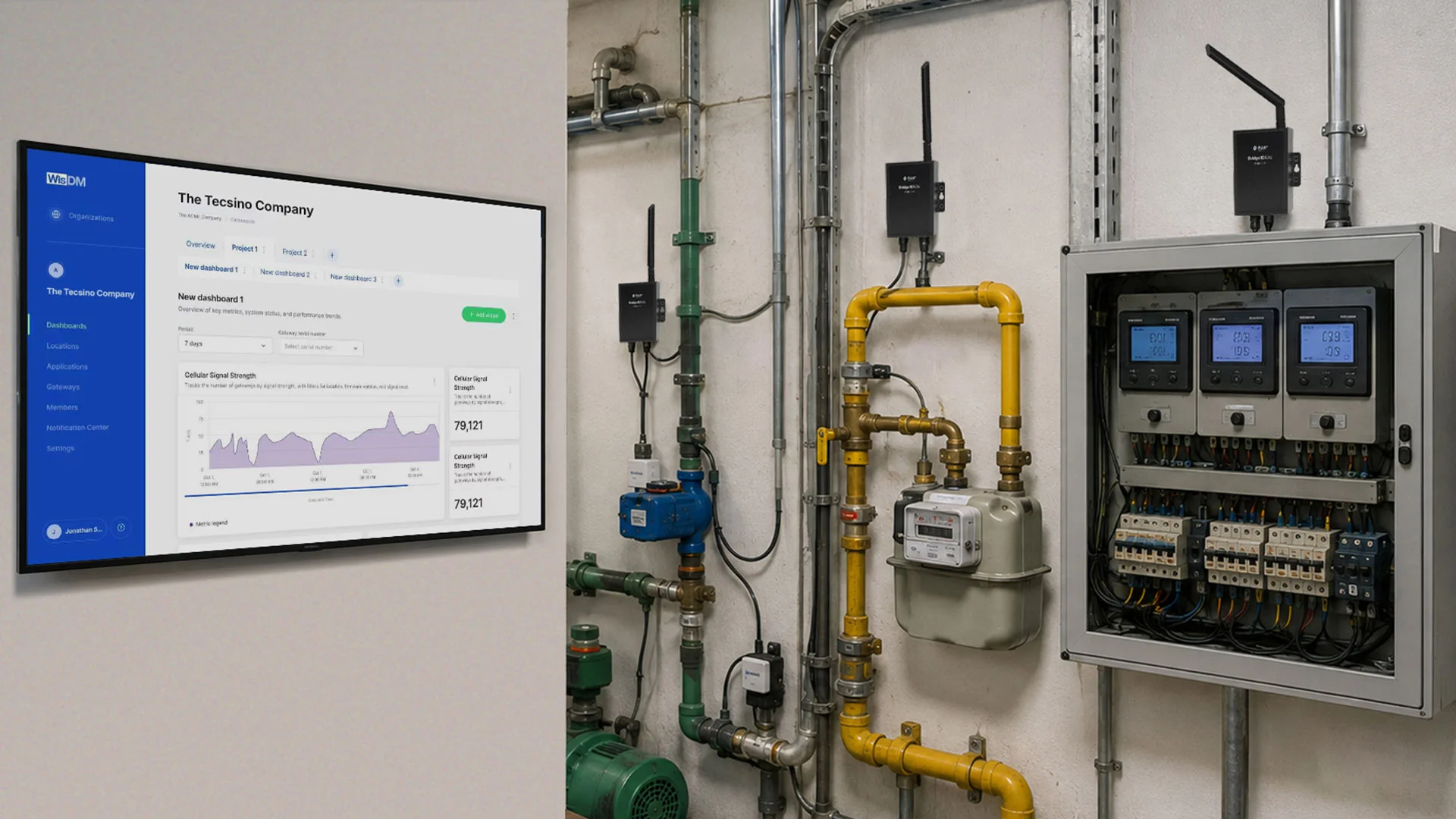
This is a cloud platform that helps teams monitor, manage, and update all their LoRaWAN gateways and devices in one place. WisDM gives utility teams centralized visibility across their connected gateways and devices. It saves time by making remote diagnostics and bulk firmware updates easy. The technical team could now track device health, fix issues quickly, and scale their network without any extra overhead.
RAKwireless helped Tecsino build a complete solution that works better, costs less to manage, and grows as they grow. By combining these products, Tecsino upgraded its entire approach towards smart utility metering.
Conclusion
This collaboration has helped Tecsino strengthen its utility management solutions in Brazil. Tecsino's clients, including major players like Comgas, now benefit from upgraded services, dependable data flow, and smoother billing. The integration of advanced telemetry with billing processing has also strengthened Tecsino’s platform and supported more efficient operations.
However, this is just the beginning, and Tecsino is poised for further innovations. With RAKwireless technology as the foundation, they plan to keep growing, improving their platform, and reaching more cities across Brazil.
Take Control of Your Utility Network Today
Contact us today to build a strong LoRaWAN network that gives you complete control and real-time visibility over your utility devices, no matter where they are.


